Showing posts with label French New Wave. Show all posts

Sunday, July 13, 2008

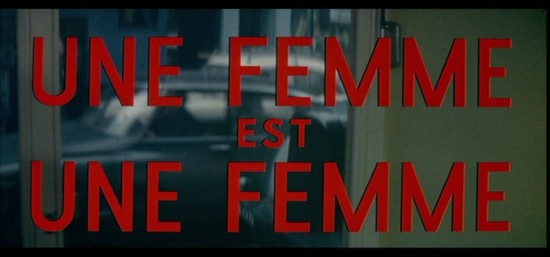
"Une Femme Est Une Femme" (Jean-Luc Godard, 1961)


The second feature film of Jean-Luc Godard's oeuvre is also his first film shot in color. It is both an experiment in style and a tribute to the American musical. At the very beginning, as words - such as "EASTMANCOLOR", "GODARD", "MUSICAL", and "CINEMA" - flash on the screen for just a moment each, we are fully aware that we're in for something we have never seen before. As our first scene begins, we - for the first time in any Godard film - see the beauty that is Anna Karina. Anna Karina's character Angela roams the streets of France before finally arriving at the place she works, a strip club. The main problem for Karina's character in "Une Femme Est Une Femme" (a.k.a. "A Woman Is a Woman") is that her love, Emile (Jean-Claude Brialy), refuses to have a child - she, of course, wants one.
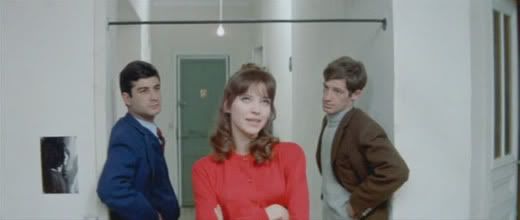


The reason I love "Une Femme Est Une Femme" so much is probably because of its energetic spirit. It feels like the cast and crew had a fun time making it, and - as a result - I had a fun time watching it. It is a very fast-paced and short (only a mere 84 minutes or so) film that goes by so quickly that I actually wanted it to last longer. Also it is a cinephile's treat with numerous pop culture references (e.g. Belmondo's character asking Jeanne Moreau how "Jules et Jim" is doing).


This is possibly the most underrated Godard film I've seen. I recommend it to anyone who is a fan of Godard or who just enjoys the cinema. It has a little bit of everything - it's funny, musical, sad, cinematic, romantic. To sum it up, it is a masterpiece - in every sense of the word.
Saturday, July 12, 2008

"Shoot the Piano Player" (François Truffaut, 1960)


While Truffaut's debut feature "The 400 Blows" is generally considered his greatest achievement, I prefer the film he did right after that - which I am reviewing now. "Shoot the Piano Player" is an incredibly inventive ode to the American B-grade crime pictures of yesteryear. The story revolves around a piano player - named Charlie (played by Charles Aznavour) - who needs to help his brothers out, as they ripped off two gangsters by taking all of "the loot". Of course we also have a tad bit of romance, which in this case is between Charlie and a woman name Lena, who works at the same club he does. Really though - like many French New Wave films - the plot isn't the important part of the film. The element that makes "Shoot the Piano Player" different from many other films with similar stories is that it uses cinematic tricks that you won't find in say a 1930's Warner Bros. gangster picture (e.g. shots that aren't in linear order).


"Shoot the Piano Player" is a definite buy for all fans of French cinema. It has everything you could want in a film of its kind and more.

Friday, July 11, 2008

"Pierrot Le Fou" (Jean-Luc Godard, 1965)


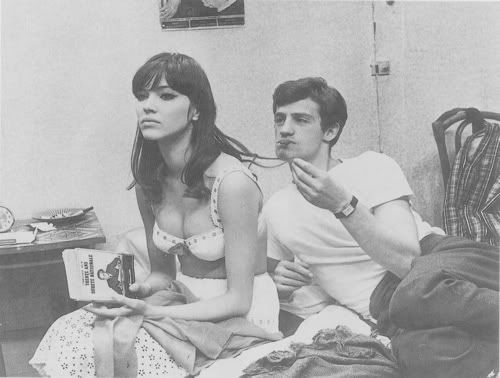
Jean-Luc Godard's 1965 masterpiece "Pierrot Le Fou", can't be easily confined to one genre of film. But if I had to, I would put it under the "lovers on the lam" category, a sub-genre of the crime picture, as it has all the hallmarks of such a film (e.g. the femme fatale who ends up double crossing the main male character). Perhaps a comparison is better, though. It is like a pop-art version of "Bonnie and Clyde". Think of an ultra-stylized "Double Indemnity" directed by "Tokyo Nagaremono" director Seijun Suzuki. The story isn't anything new, but - as we expect from Godard - bursts of originality are obvious from the very beginning, in which we first meet the two main characters, Ferdinand (played by the ultra-cool Jean-Paul Belmondo) and the woman Ferdinand and his wife hired to be their childrens' babysitter, Marianne (played by the sexy and swanky Anna Karina). Once Belmondo returns home from a shag party (which is attended by none other than the great Samuel Fuller), he gets Marianne in his car and drives her to her house. On the drive there, we'll learn that the two were former lovers. Naturally (since the story needs to progress), they get back together. In order to escape some gangsters that are following Marianne, the two run away in hopes of escaping - which in turn leads us to the main bulk of the film.


"Pierrot Le Fou" - with its luscious cinematography by Raoul Coutard, incredible performances by Karina and Belmondo, and the master direction by Jean-Luc Godard - is a film that should not be missed by any cinephile. I for one was lucky enough to have had the opportunity to see it on the big screen, which was an experience I'll never forget. But for those of you are unable to do so, do yourself a favor and buy the 2-disc Criterion edition immediately (it's a great set that I display proudly on my shelf), and sit back and enjoy one of the all time great films.